
Why Visit?
Tokyo has no shortage of famous landmarks, but Shibuya Crossing is unusual because the attraction is simply the city going about its everyday life.
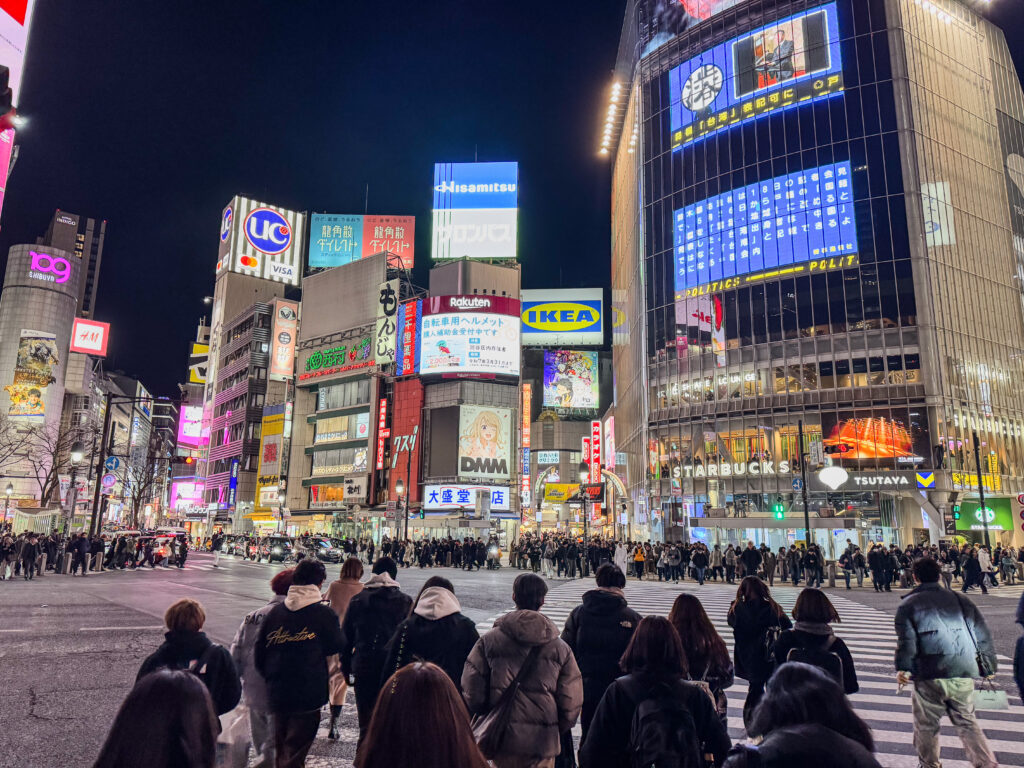
There is no monument to enter or exhibition to explore. Instead, you stand at one of Tokyo’s busiest intersections and watch the rhythm of the city unfold. When the lights change, the traffic disappears and pedestrians take over the entire crossing before the roads reopen again.
The surrounding streets add to the spectacle. Giant digital screens, department stores, fashion shops, restaurants and entertainment venues create the backdrop, while Shibuya’s famous youth culture continues to shape the neighbourhood.
From Railway Station to Global Landmark
Shibuya’s transformation began long before the crossing became an international icon.
Shibuya Station first opened in 1885, and the area expanded rapidly as additional railway connections turned it into an important transport and commercial hub. The station now serves multiple major railway and subway lines, helping make Shibuya one of Tokyo’s busiest urban centres.
The crossing developed alongside this growth. As more people began passing through the station and surrounding shopping districts, the intersection became an increasingly important meeting point.
Today, almost three million passengers pass through Shibuya Station each day, helping explain why the streets around it can feel almost constantly in motion.
The Moment the Lights Change
The best part of Shibuya Crossing is the few seconds between traffic stopping and the crowd beginning to move.
For a moment, the intersection is almost empty. Cars wait behind the lines while pedestrians gather at each corner.
Then the signal changes.
People begin crossing from every direction at once. Some walk quickly, others stop to take photographs, while commuters move through the crowd as though it were an ordinary part of their day. Somehow, thousands of people navigate the same space without turning it into complete chaos.
The crossing has become famous precisely because of this balance between scale and order.
Watching from Above
Crossing the street is only half the experience.
The movement becomes easier to appreciate from above, where the individual pedestrians merge into constantly shifting patterns. Several cafés, shops and buildings around the intersection offer elevated views, while the station itself provides viewpoints between its various railway entrances.
For a more dramatic perspective, SHIBUYA SKY rises approximately 229 metres above the station and provides a panoramic view of the crossing and the surrounding city. From here, the crowds below become part of the wider landscape of Tokyo.
The view changes completely after dark, when the surrounding screens and illuminated buildings turn the intersection into a glowing urban spectacle.
More Than Just a Crossing
Shibuya Crossing is often treated as a single attraction, but the streets surrounding it are part of what makes the experience worthwhile.
Walk across the intersection towards Center-Gai and the atmosphere quickly changes. The pedestrian street leads into one of Shibuya’s main shopping and entertainment areas, filled with fashion stores, restaurants, bars and karaoke venues.
Nearby, SHIBUYA109 has been a major influence on Tokyo’s youth fashion since opening in 1979. Dogenzaka offers another side of Shibuya, with restaurants, nightlife and smaller streets branching away from the main crowds.
The crossing is therefore less a destination in isolation and more an introduction to one of Tokyo’s most energetic neighbourhoods.
A Meeting Point with a Story of Its Own
Just beside the station stands another of Shibuya’s most recognisable landmarks: the statue of Hachiko.
The Akita dog became famous for returning to the station for years after his owner, University of Tokyo professor Hidesaburo Ueno, died unexpectedly in 1925. Hachiko continued waiting for his owner for nearly a decade, and his story eventually became a symbol of loyalty in Japan.
Today, the Hachiko statue is one of Tokyo’s most popular meeting points. It also provides a useful starting point for exploring the crossing, with the Hachiko Exit of Shibuya Station leading directly towards it.
How to Experience Shibuya Crossing
Start at the Hachiko Exit of Shibuya Station and make your way towards the intersection.
Cross once without stopping. Then cross again from a different direction and take a moment to watch the crowds from one of the surrounding viewpoints.
Afterwards, walk into Center-Gai or Dogenzaka to experience the streets that surround the crossing. If you have more time, head upwards for a panoramic view from SHIBUYA SKY.
The crossing itself takes only a few minutes to experience, making it an easy addition to almost any Tokyo itinerary.
What Makes This Experience Special?
Most famous landmarks are things you go somewhere to see.
Shibuya Crossing is different. What you are watching is the city itself.
Thousands of people cross the same intersection every few minutes, yet no two crossings look exactly alike. The crowd changes, the light changes and the surrounding screens constantly shift the atmosphere.
It also captures something fundamental about Tokyo. The city is enormous, highly organised and constantly moving, yet the experience remains remarkably human. Everyone is simply trying to get somewhere.
For a few moments, all those individual journeys meet in the same place.
Practical Information
- Starting Point
Shibuya Station’s Hachiko Exit is the easiest starting point and leads directly towards the crossing.
- Best Time to Visit
After dark is ideal if you want to experience the illuminated screens and surrounding nightlife. For a quieter look at the crossing, visit outside the busiest evening periods.
- Photography
For the classic street-level photograph, position yourself at one of the corners and capture the crowd as the lights change. For an elevated view, explore the surrounding cafés, station viewpoints or SHIBUYA SKY.
- Duration
Allow around 30 to 60 minutes for the crossing itself and its surrounding viewpoints. Add several hours if you plan to explore Center-Gai, Dogenzaka, the shops and restaurants nearby.
- Cost
Crossing Shibuya itself is free. Viewing the intersection from commercial observation facilities may require admission.
One Hour Tourist Verdict
Shibuya Crossing is one of those rare places where a completely ordinary part of city life becomes an unforgettable experience.
The crossing takes only a few minutes, yet the scale of the crowds, the surrounding screens and the constant movement make those few moments feel much bigger. Add a view from above, a walk through Center-Gai and a visit to Hachiko, and the area becomes a compact introduction to modern Tokyo.
For OneHourTourist, it is an ideal stop. You can experience the crossing in less than an hour, but once you see the city moving around you, there is a good chance you’ll want to stay longer.